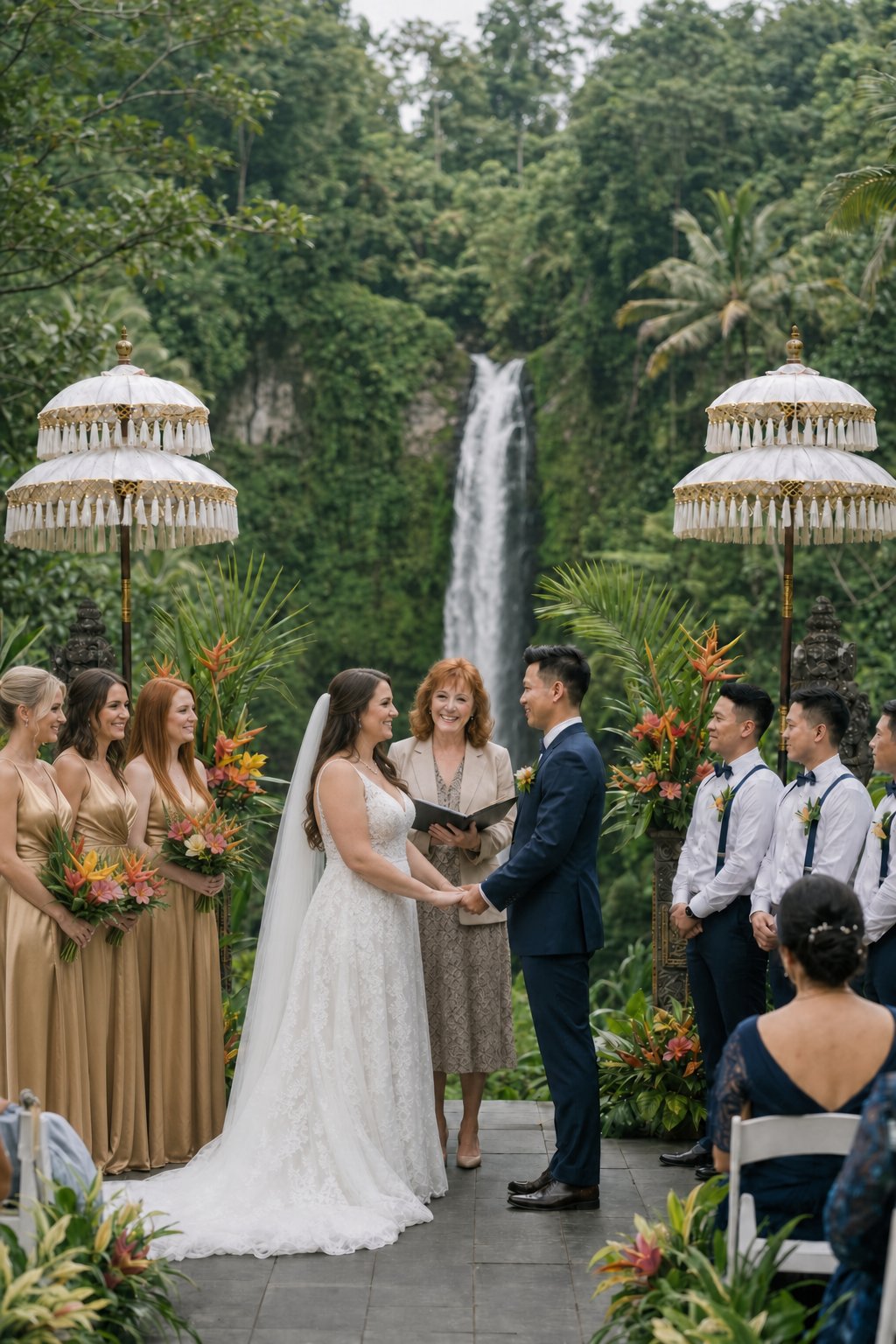
Hindu Ceremony
Hindu Weddings in Bali
Indian and Hindu weddings in Bali, with the mandap, rituals, catering and multi-day events coordinated around your traditions.
An Indian or Hindu wedding is a celebration on a different scale, and Bali rises to meet it. The island offers the space, the settings and the warmth for a mandap ceremony surrounded by family, along with the room to spread festivities across several days of events. For couples wanting a destination wedding that honours their traditions, it is a natural choice.
The logistics, though, are considerable, from arranging the right priest to coordinating specialist catering and a multi-day schedule. Send one enquiry and the planner we match you with takes it on, working respectfully with your family's customs to bring the mandap, the rituals, the menus and each celebration together into one day that flows.
Indian Hindu and Balinese Hindu weddings are not the same
Worth clearing up early. When people say "a Hindu wedding in Bali", they can mean two very different things. This page is about an Indian Hindu wedding brought to the island. A Balinese wedding, the pawiwahan, is the local religious ceremony of Balinese Hindus, and it is genuinely different, a distinct tradition rather than another style of the same rite.
Indian Hindu wedding
- Tradition
- Vedic and pan-Indian, with many gods and strong regional variations.
- The ceremony
- A pandit leads vows around the sacred fire, Agni; the seven steps, the saptapadi, complete the marriage, with the kanyadaan and the tying of the mangalsutra.
- The date
- A shubh muhurat, chosen by an astrologer from the couple's birth charts.
- For a couple in Bali
- A celebration you bring and recreate at a villa or resort, with the legal registration handled separately.
Balinese Hindu wedding (pawiwahan)
- Tradition
- Agama Hindu Dharma, Hinduism woven with local ancestor worship and animism, centred on one supreme being, Sang Hyang Widhi Wasa, and the Tri Hita Karana philosophy of harmony.
- The ceremony
- A pemangku or pedanda priest blesses the couple with holy water (tirta) and offerings (banten); the mekala-kalaan purification, and the bride's leave-taking of her ancestors (mepamit) to join the groom's family temple.
- The date
- A dewasa ayu, a good day chosen by a priest from the Balinese pawukon calendar.
- For a couple in Bali
- A community and temple-bound religious ceremony for Balinese Hindus, tied to family and village, not an off-the-shelf style to book.
Both are beautiful, and both deserve respect. If you are bringing an Indian Hindu wedding, everything below is for you. If you are drawn to the Balinese ceremony, read our full guide to Balinese Hindu weddings (pawiwahan).
Planning a Hindu wedding in Bali
Mandap & rituals
The mandap, the priest and the ceremonial elements arranged around your traditions.
Specialist catering
Caterers sourced for the menus and dietary needs your celebration calls for.
Multi-day events
Venues, vendors and schedule coordinated across each day of the festivities.
Want a hand from the start? See our wedding planner service, or browse all-inclusive wedding packages.
The steps to an Indian Hindu wedding
A Hindu wedding is a multi-day celebration, and, unusually, the date is chosen for you rather than by you. Because of that and the scale of it, this is a wedding to start planning well ahead.
Engage a pandit
A pandit, the priest, officiates the wedding and first works out your auspicious date and time from your birth details. Everything else is planned around what the pandit sets.
Set the auspicious date and time (muhurat)
The muhurat is calculated for you personally, from your birth charts, so it is not a fixed public date and it varies by tradition and region. Your pandit fixes it, and your planner then builds the celebration around that day.
The pre-wedding events
Over a day or two before the wedding come the joyful gatherings: mehndi (henna), sangeet (an evening of music and dance) and haldi (the turmeric blessing), often with a small puja to begin.
The ceremony at the mandap
Under the mandap come the heart of the rites: the kanyadaan, when the bride is given away, the saptapadi, seven steps around the sacred fire, each a vow, and the tying of the mangalsutra. A reception, usually on the final day, closes the celebration.
Legal registration
Indonesia recognises religious marriage, and both partners share one religion. Foreign couples arrange a Certificate of No Impediment directly with their own embassy, translate their documents with a sworn translator, and register at the civil registry, the Dinas Kependudukan dan Pencatatan Sipil or Dukcapil for short. Whether a visiting pandit's ceremony alone satisfies civil registration can be nuanced, so many couples handle the legal step separately. Your planner and a local marriage specialist guide you through it.
Read more: having your Bali marriage recognised in your home country, with honest guides by nationality.
Choosing your date
Because the muhurat is chosen for you, the date question is really one for your pandit. It helps to know, though, that some periods are traditionally set aside for weddings.
Periods traditionally avoided
In much of Hindu tradition, weddings are not held during certain windows. The best known is Chaturmas, roughly late July to early November, when weddings pause. The occasional extra lunar month (Adhik Maas) and the ancestor-remembrance fortnight of Pitru Paksha, around September to October, are also usually avoided.
- Chaturmas 2026: from about 25 July into early November.
- 2027 and 2028: similar windows, roughly mid-July into November, shifting each year.
These dates move each year and depend on tradition, so your pandit or astrologer confirms the right day for you.
Marrying in the local Balinese-Hindu tradition instead? There, an auspicious day, the dewasa ayu, is chosen by a pemangku priest from the Balinese calendar, and your planner can arrange that too.
How Wedding in Bali works
- Step 1
Explore
Read honest guides on venues, packages, costs and styles to shape your Bali wedding, birthday or event.
- Step 2
Enquire once
Send a single enquiry with your date, guest count and budget. Prefer to chat? WhatsApp works too.
- Step 3
We match you
We connect you with the right Bali wedding planner for your day, your style and your budget.
- Step 4
Plan with confidence
Your matched planner sends a tailored quote and handles the details, so you can enjoy the day.
Start here
Send your enquiry
Tell us about your day and we match you with the right Bali wedding planner. We reply within minutes during Bali hours.
Common questions
Can we have an Indian or Hindu wedding in Bali?
Yes. Bali is a popular destination for Indian and Hindu weddings, with settings that suit a mandap ceremony and the space to host multi-day celebrations. The planner we match you with coordinates the priest, the rituals and the logistics around your traditions.
Can you arrange a mandap and priest?
The planner we match you with arranges the mandap, the priest and the ritual elements your ceremony calls for, working respectfully with your family's customs. Share your traditions in your enquiry and the planner builds the day around them.
Is specialist catering available?
Yes. Indian and Hindu weddings often call for specific menus and catering, and the planner we match you with sources caterers who can deliver the dishes and dietary needs your celebration requires.
How do we plan a multi-day Hindu wedding in Bali?
Send one enquiry with your dates, guest count and the events you are planning. The planner we match you with coordinates the venues, vendors and schedule across each day so the whole celebration runs smoothly.