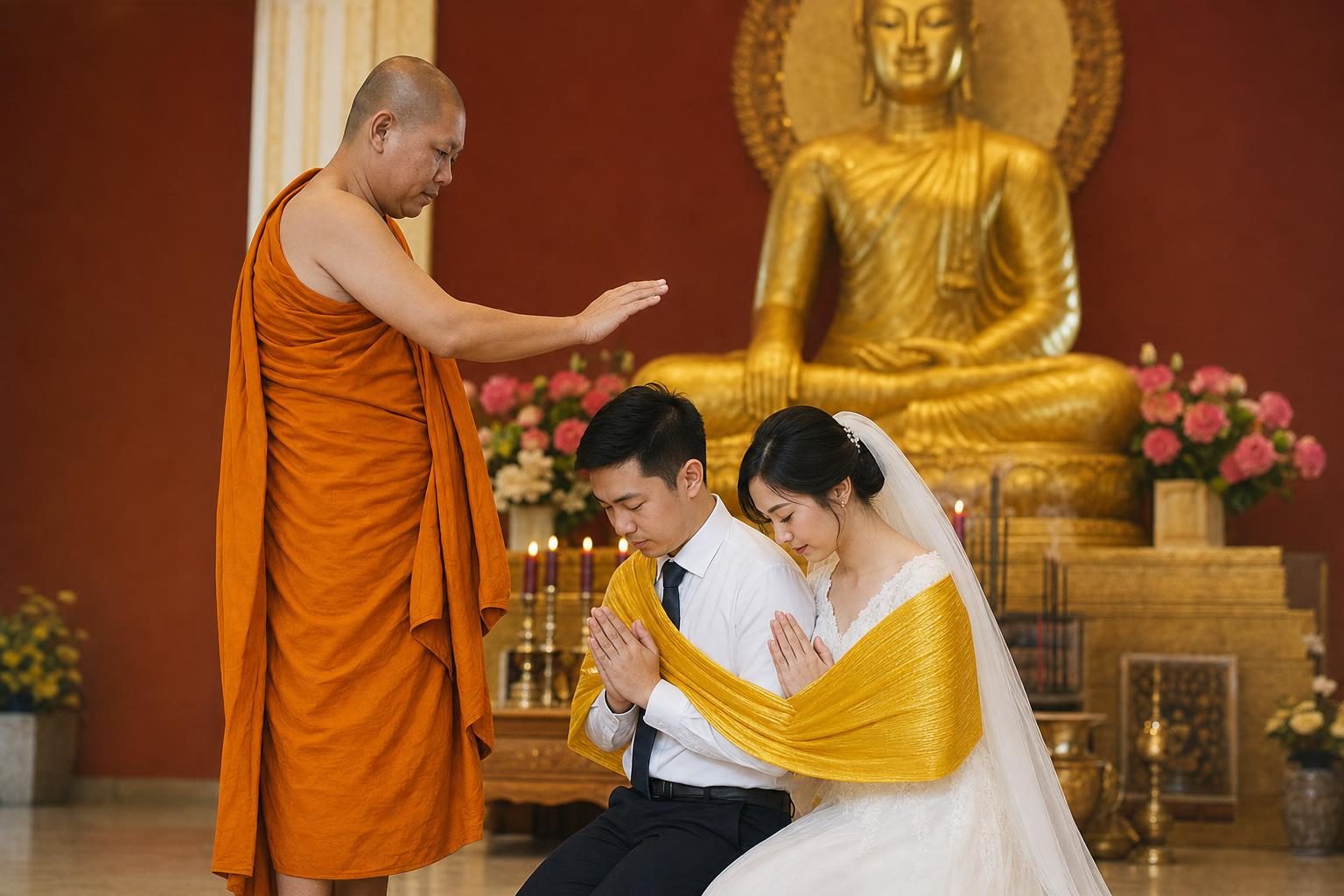
Buddhist Ceremony
Buddhist Weddings in Bali
A bhante-led blessing in a Bali vihara, calm, respectful and arranged with cultural care through one enquiry.
A Buddhist wedding carries a quiet, grounded beauty. The soft rhythm of chanting, the offerings, the blessing with holy water: it sets a tone of calm and intention that few other ceremonies match. For couples drawn to something peaceful and meaningful, a bhante-led blessing is a gentle, heartfelt way to begin married life.
Arranging one well takes local knowledge and a respectful touch, and that is the part we make easy. Send one enquiry and the planner we match you with coordinates the bhante, the temple or setting, and the paperwork, working carefully with the traditions you hold, so you can simply be present in the moment.
Where to have a Buddhist wedding in Bali
The first question most couples have is simply where a Buddhist ceremony can happen here. There are two honest answers, and your planner confirms which one fits your date.
At a vihara (a Buddhist temple)
This is the traditional and most straightforward path. A vihara is a Buddhist temple where the community worships and monks teach. Bali is mostly Hindu, but it has established, active viharas, among them Brahmavihara-Arama near Banjar in the north, the island's largest Buddhist monastery, and the historic Vihara Dharmayana in Kuta.
By the traditions of Indonesia's Buddhist council, a bhante is generally expected to lead the ceremony inside the temple rather than travel to a villa or beach, so a vihara blessing is usually the surest route. Which temple will host your blessing is something your planner arranges and confirms for your date.
At a private venue, with care
Some couples picture a garden, a villa or a beach, with a bhante present. Whether that is possible depends on the officiant and the council's rules, and it is not guaranteed, so some couples pair a temple blessing with a private celebration afterwards.
Tell us the setting you have in mind and the planner we match you with will tell you honestly what works for your date, rather than promise something the tradition may not allow. Either way, it starts with one message.
Who leads the ceremony: the bhante
You may see the officiant called a bhante, a biksu or a Pandita. They all refer to a Buddhist monk or ordained teacher, the person who leads the chanting and the blessings. If English is not your first language, or your guests are new to the rite, your planner can arrange an officiant who explains each step so everyone can follow and feel part of the day.
What happens in a Buddhist ceremony
A Buddhist blessing, sometimes called Vivahamangala, unfolds gently. You begin by offering flowers and fruit at the altar and paying respects to the Buddha. The bhante leads paritta, the soft, rhythmic chanting that gives the ceremony its calm.
You hold incense and speak your vows of respect, faithfulness and care, and many couples are welcome to add words of their own. The bhante binds your wrists with a yellow ribbon, and your parents drape you both in yellow cloth, a quiet symbol of the union and the family around it. Blessing water is sprinkled with wishes for your happiness, and the bhante closes with gentle guidance for the life you are starting together.
The steps to a Buddhist wedding
The Vivahamangala takes a little preparation, so it helps to plan a couple of months ahead, and longer for foreign couples.
Contact the vihara
You begin by contacting the vihara or the Pandita, who guides you on what to prepare, the documents you will need, and how the blessing will run.
Prepare the documents
You gather your ID card, family card and birth certificates, along with your witnesses. Foreign couples add an embassy Certificate of No Impediment and documents translated into Indonesian by a sworn translator. The papers usually need to reach the vihara at least a month before the day.
Pre-marriage guidance
Couples attend marriage guidance sessions before the blessing, often cited as around eight, though the number varies by vihara. Because they run on a schedule, it is worth starting early rather than close to your date.
The Vivahamangala blessing
Then comes the blessing itself, led by a Pandita or bhante as described above. Afterwards the vihara issues a Buddhist marriage certificate, your record of the ceremony.
Legal registration
To make the marriage legal, you register at the civil registry, Dukcapil, not the KUA, using the vihara's certificate. More on that just below.
Choosing your date
Buddhist tradition favours the full-moon day as the most auspicious, but the full and new moon are also the observance days when temples are busiest, and some viharas hold blessings only on set days. One time is best avoided altogether.
Waisak, the vihara's busiest day
Waisak (Vesak) is the great Buddhist festival, a national holiday on the Vesak full moon in May, when viharas hold large observances and are at their busiest. It is best kept clear of a wedding booking.
- 2026: Sunday 31 May.
- 2027: Thursday 20 May.
- 2028: Tuesday 9 May.
Waisak is set each year by government decree, so far-out dates are confirmed closer to the time.
Is a Buddhist wedding in Bali legal?
It can be a legal marriage, not only a blessing. Buddhism is one of Indonesia's official religions, so a marriage becomes valid once the religious rite is performed and then recorded with the civil registry, the Dinas Kependudukan dan Pencatatan Sipil, better known as Dukcapil (the short form we will use here). The vihara issues a blessing certificate that feeds that registration.
One honest point worth checking first: if you are marrying as a foreign national, the documents from your own country, such as a Certificate of No Impediment, are yours to arrange directly with your embassy or consulate. Embassies deal only with their own citizens, so a local planner cannot file these for you. We tell you exactly what to obtain and by when.
The Indonesian side of the registration is where we help most. We map out the steps with you, and if either of you is Indonesian, what is required also depends on your ID card (KTP) and registered domicile. If you would rather keep things symbolic, a Balinese blessing is the gentler, non-legal alternative.
One last thing if you are not Indonesian. Your marriage is fully legal here in Indonesia, and your marriage certificate is the proof. To have it recognised in your own country, you usually report or register that certificate back home after the wedding, often through your embassy or your country's registry, once it is apostilled and translated. Whether you must, and how, depends on where you are from.
Read more: is your Bali wedding legal in your home country? Honest guides, by nationality.
A Buddhist ceremony, handled with care
Bhante-led blessing
A Buddhist monk leads the chanting, vows and blessing at the heart of the day.
Held at a vihara
The traditional home for the ceremony is a Buddhist temple, arranged for your date.
Paperwork guided
Your planner walks you through the blessing certificate, registration and any documents.
Drawn to a symbolic ceremony instead? See a Balinese blessing. Want help with the whole day? See our wedding planner service, or explore serene Ubud.
How Wedding in Bali works
- Step 1
Explore
Read honest guides on venues, packages, costs and styles to shape your Bali wedding, birthday or event.
- Step 2
Enquire once
Send a single enquiry with your date, guest count and budget. Prefer to chat? WhatsApp works too.
- Step 3
We match you
We connect you with the right Bali wedding planner for your day, your style and your budget.
- Step 4
Plan with confidence
Your matched planner sends a tailored quote and handles the details, so you can enjoy the day.
Start here
Send your enquiry
Tell us about your day and we match you with the right Bali wedding planner. We reply within minutes during Bali hours.
Common questions
Can we have a Buddhist wedding in Bali?
Yes. The most traditional path is a bhante-led blessing inside a vihara, a Buddhist temple, and the planner we match you with arranges the ceremony and works respectfully with the traditions that matter to you.
Where can a Buddhist wedding be held in Bali?
Usually inside a vihara. Bali has established Buddhist temples, and which one hosts your blessing is something your planner confirms for your date. A ceremony at a private venue is sometimes possible too, so tell us what you are hoping for and we will tell you honestly what works.
Who leads a Buddhist wedding ceremony?
A bhante, also called a biksu or Pandita: a Buddhist monk or ordained teacher who leads the chanting and the blessings. Your planner arranges an officiant who explains each step so you and your guests can follow along.
What happens during a Buddhist wedding ceremony?
Offerings at the altar and respects to the Buddha, paritta chanting, your vows, the binding of your wrists with a yellow ribbon and yellow ceremonial cloth, and a blessing with holy water, followed by gentle words of guidance for married life.
Is a Buddhist wedding in Bali legally recognised?
Buddhism is one of Indonesia's official religions. A marriage is valid once the religious rite is performed and recorded with the civil registry, known as Dukcapil, and the vihara issues a blessing certificate that feeds that registration.
What do foreign couples need for a Buddhist wedding in Bali?
Usually a Certificate of No Impediment from your embassy plus translated documents, which you arrange directly with your own embassy since they deal only with their own citizens. Your planner maps the Indonesian-side steps; the exact checklist depends on your country.
Can we write our own vows?
Often yes, alongside the traditional elements. Share what you would like to say and your planner and the bhante shape the ceremony so it feels like yours.
How do we arrange a Buddhist wedding in Bali?
Send one enquiry with your date and guest count. The planner we match you with coordinates the bhante, the vihara or setting, and the paperwork, with care and cultural respect.