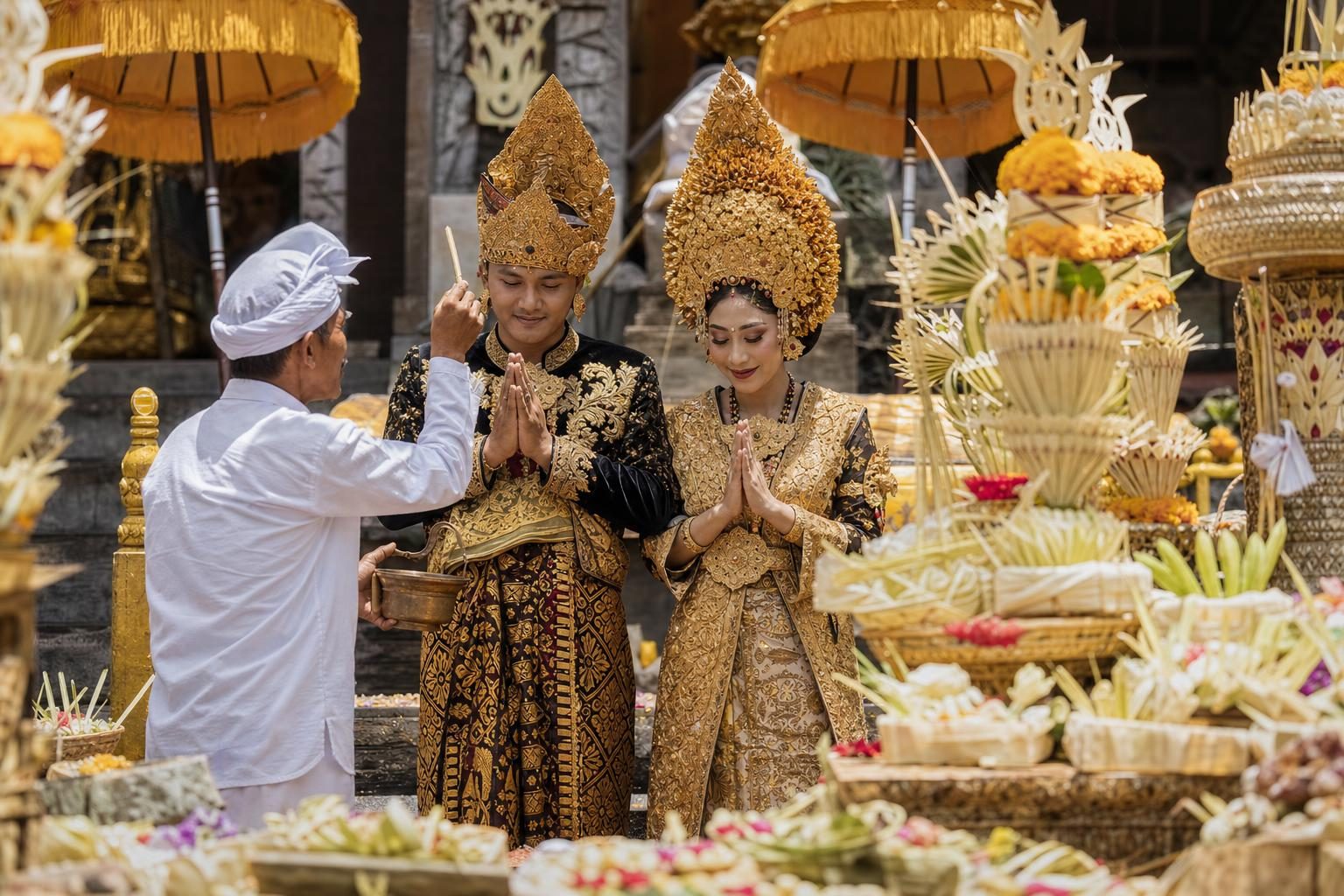
Balinese Ceremony
Balinese Hindu Weddings
The pawiwahan, Bali's own Hindu wedding of holy water, offerings and family, arranged with real respect through one enquiry.
A Balinese Hindu wedding, the pawiwahan, is one of the most beautiful ceremonies on the island, and one of the most deeply rooted. It follows Agama Hindu Dharma, Bali's own form of Hinduism, woven together with ancestor worship and local belief over more than a thousand years. It is a religious rite and a community occasion at once, joining not just two people but two families, their lineages and their temple.
Because of that, it is different from an Indian Hindu wedding, and different again from a symbolic blessing. This page walks you through what a pawiwahan actually involves and how it is arranged, honestly and with respect for a living tradition.
Who leads it, and how it looks
A pemangku, a temple priest, leads most weddings; for a grander ceremony a pedanda, a high priest, presides. The priest conducts the purification and the blessings with holy water and offerings, guiding the couple and their families through each rite.
The look is unmistakable. The couple wear payas agung, the grand ceremonial dress: gold songket cloth and tall, ornate golden headdresses, with the temple courtyard dressed in woven palm-leaf offerings, frangipani and ceremonial umbrellas. It is rich, formal and full of meaning.
Inside a pawiwahan
Rather than vows around a sacred fire, a Balinese wedding turns on purification and blessing. The priest sprinkles holy water, tirta, and presents offerings, banten and canang, arrangements of flowers, fruit and rice that honour the gods and the ancestors.
At its heart is the mekala-kalaan, a purification that cleanses the couple of negative influences before married life, told through gentle symbolic acts. Later comes the mepamit, when the bride takes leave of her own ancestors to join the groom's family and their ancestral temple. That is the quiet meaning of the day: two families and two lineages becoming one.
The steps to a Balinese Hindu wedding
A pawiwahan is arranged with family and community at its centre, so it rewards planning together and starting early.
Family and community
It begins with the two families and, for Balinese couples, the local community, the banjar, who share in the preparations and recognise the marriage. The groom's family traditionally hosts, and much is arranged together rather than booked as a package.
An auspicious day (dewasa ayu)
A priest chooses the dewasa ayu, the good day, from the Balinese pawukon and saka calendars, matching favourable day-cycles. It is not picked from convenience, so the date follows the calendar and the priest's guidance.
Offerings and preparation
The banten and canang offerings are prepared, often by hand over days, along with the payas agung dress and the temple setting. Your planner can coordinate the priest, the offerings makers and the dressers so nothing is rushed.
The pawiwahan, then registration
The ceremony is held with the priest, family and witnesses. To make it a legal marriage, it is then recorded with the civil registry, the Dinas Kependudukan dan Pencatatan Sipil or Dukcapil for short, which issues your marriage certificate.
Choosing your date
The dewasa ayu comes from the priest, not a wall calendar, so the day is chosen for its meaning. It is also worth knowing that around Bali's great temple days, such as Galungan and Kuningan, and around the silent day of Nyepi, priests and families are occupied, so weddings are usually planned away from those windows. Your planner and priest confirm a fitting day.
Is a Balinese Hindu wedding legal, and can we have one?
Hinduism is one of Indonesia's official religions, so a pawiwahan can be a legal marriage once the religious ceremony is recorded with the civil registry (Dukcapil), which issues the marriage certificate. As with all marriages in Indonesia, both partners share one religion, so a genuine pawiwahan is for a couple who are both Hindu.
This is where we ask you to be honest with yourself, and we will be honest with you. A pawiwahan is a living religious ceremony bound to family, village and temple, not a style to book for the photos. If you and your partner share the Hindu faith, tell us and the planner we match you with will guide the ceremony and the paperwork respectfully. If you love the beauty of it but not the faith, the gracious option is a symbolic Balinese blessing, which carries the look and the warmth without the religious and legal weight. The exact requirements for a couple's own situation are best confirmed with your planner and a local notary.
A pawiwahan, handled with care
Priest-led rites
A pemangku or pedanda leads the purification and blessings with holy water and offerings.
Offerings and dress
Hand-made banten and canang, and the grand payas agung, coordinated with care.
Registration guided
The marriage recorded with Dukcapil so it is legal, walked through step by step.
Looking for the Indian tradition instead? See Indian Hindu weddings. Prefer a symbolic ceremony? See a Balinese blessing, or browse all Bali wedding venues.
How Wedding in Bali works
- Step 1
Explore
Read honest guides on venues, packages, costs and styles to shape your Bali wedding, birthday or event.
- Step 2
Enquire once
Send a single enquiry with your date, guest count and budget. Prefer to chat? WhatsApp works too.
- Step 3
We match you
We connect you with the right Bali wedding planner for your day, your style and your budget.
- Step 4
Plan with confidence
Your matched planner sends a tailored quote and handles the details, so you can enjoy the day.
Start here
Send your enquiry
Tell us about your day and we match you with the right Bali wedding planner. We reply within minutes during Bali hours.
Common questions
What is a Balinese Hindu wedding?
It is the pawiwahan, the traditional religious wedding of Balinese Hindus. Rather than vows around a fire, it centres on purification with holy water (tirta), offerings (banten), and the couple joining their families and ancestral temple. It follows Agama Hindu Dharma, Bali's own form of Hinduism, and it is a community event as much as a couple's.
Who leads a Balinese Hindu wedding?
A pemangku, a temple priest, or for a grander ceremony a pedanda, a high priest, leads the rites. They conduct the purification and the blessings with holy water and offerings. Your planner can arrange the priest and the preparations respectfully.
How is it different from an Indian Hindu wedding?
They are two distinct traditions, not two styles. An Indian Hindu wedding centres on a pandit and the sacred fire, with the seven steps completing the marriage. A Balinese pawiwahan centres on holy water, offerings and the mekala-kalaan purification, and is tied to family, village and temple. See our Indian Hindu wedding page for that side.
Can a foreign couple have a Balinese Hindu wedding?
A true pawiwahan is a religious ceremony for Balinese Hindus, deeply tied to family and community, and both partners would need to be Hindu for it to be a genuine religious and legal marriage. If you are drawn to its beauty rather than the faith itself, a symbolic Balinese blessing is the respectful option. Tell us your situation and we will guide you honestly.
When is a Balinese Hindu wedding held?
On a dewasa ayu, an auspicious day chosen by a priest from the Balinese pawukon calendar. Some periods around major temple days are avoided or very busy, so your priest and planner find a fitting day.
How do we arrange a Balinese Hindu wedding?
Send one enquiry with your date and details. The planner we match you with coordinates the priest, the offerings, the setting and the paperwork, working with real respect for the tradition and your family.