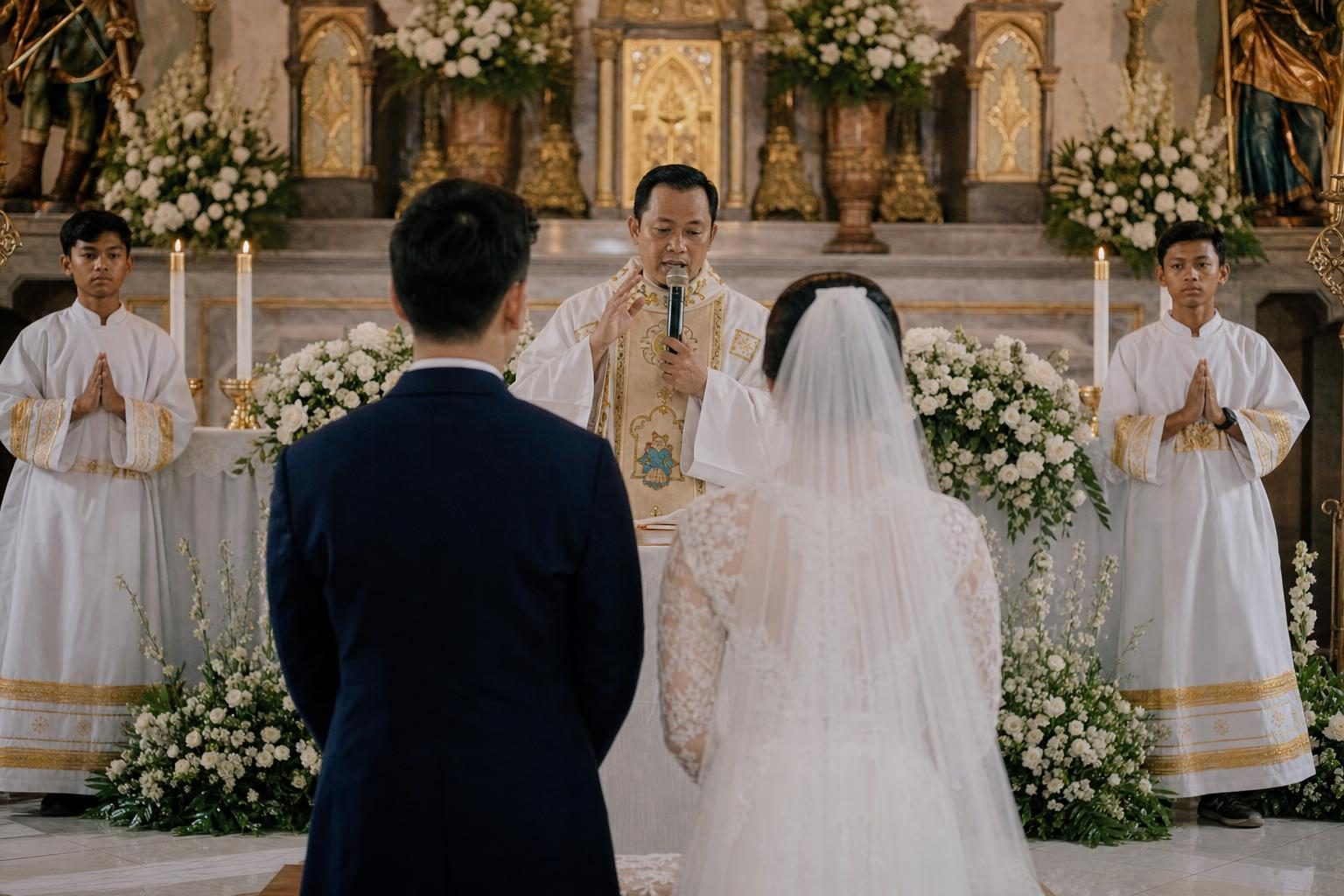
Catholic Ceremony
Catholic Weddings in Bali
A priest-led Catholic church wedding in Bali, arranged with care for your faith and your paperwork, through one enquiry.
A Catholic wedding is a sacrament first and a celebration second. The vows you make before God carry a weight that no other part of the day does, and Bali lets you hold that solemnity and the joy that follows it with real grace. For a couple who want their marriage blessed properly, a priest-led church ceremony is not a formality to work around; it is the heart of the day.
The honest part is that the church, the priest, the certificates and the civil paperwork all need arranging from the ground, and often from your home parish too. Send one enquiry and the planner we match you with coordinates it respectfully, working with what your parish requires, so you can focus on the promise you are making rather than the logistics behind it.
Where to have a Catholic wedding in Bali
This is the question most couples ask first, and it deserves an honest answer. A Catholic wedding belongs in a church, and Bali genuinely has the churches to make that possible.
In a Catholic church
Because the wedding is a sacrament, the ceremony is celebrated in a Catholic church, not at a villa, a beach or a commercial chapel. That is not a limitation so much as the meaning of the day, and Bali is served by the Diocese of Denpasar with established, active parishes. There is the Cathedral of the Holy Spirit in Denpasar, churches around Kuta, Nusa Dua and Tuka in the south, and the historic Sacred Heart church at Palasari in the west, the first Catholic church in Bali, known for its Balinese-Gothic architecture.
Which of these can host your wedding depends on your parish documents and the priest, so the planner confirms it for your date rather than promising a specific church in advance. That way you know where you stand from the start.
The reception, wherever you dream
If you had pictured a beach or a garden, you can still have it. The church holds the vows; the reception holds the celebration. A garden lunch, an evening by the sea, a villa dinner under the palms: the party afterwards can be exactly the Bali you imagined.
Tell us the church feel you are hoping for and the celebration you want to follow it, and the planner we match you with shapes both. One message, and you learn which church can host your date, what your parish will need, and where your reception can be.
Who leads the ceremony: the priest
A Catholic priest, called a romo or pastor, celebrates the nuptial ceremony or Mass. If English is not your first language, or your guests are new to the rite, an English-speaking priest can usually be arranged so everyone can follow along and feel part of the day. Your planner works with the parish throughout, with respect for how the ceremony should be kept, never treating it as a booking to rush.
What the Church asks for
The requirements can look daunting written out as a list, so it helps to see them as a few plain steps rather than red tape. For the Catholic partner, the church will want your baptism and confirmation certificates. Most couples take a marriage preparation course, in Indonesia the Kursus Persiapan Perkawinan or KPP for short, usually some months ahead, which gives you a certificate the church needs when you register the marriage.
Your home parish provides a letter of freedom, confirming you are free to marry, and a letter of delegation or permission so that a priest in Bali may marry you. At least one partner needs to be a baptised, practising Catholic; where the other is not Catholic, a permission or dispensation can usually be arranged through the parish, and it is a normal, well-worn path rather than a barrier. International couples also complete a Certificate of No Impediment and translated documents.
The exact checklist depends on your parish and your country, and the current diocese process is best confirmed for your situation, so your planner walks you through it step by step and tells you what to gather and when.
The steps to a Catholic wedding
A Catholic wedding is a sacrament, not a quick booking, and it rewards planning ahead. Between the preparation course, a conversation with the priest and the parish's own calendar, most couples find that six months or more is realistic. A date only three months away is often too soon and ends up moving, so it helps to know the steps early.
Apply through your community, then your parish
A Catholic wedding takes a few more steps at the start than a Protestant one, and it begins in your local church community. You ask its leader, the ketua lingkungan (in some dioceses this small community is a Komunitas Basis Gerejawi, or KBG), for a letter of introduction, the surat pengantar. Both of you do this, each through your own community, and if you belong to different parishes, each parish issues its own letter and the two are coordinated. You then take the letters to the parish secretariat, the sekretariat paroki, to register the wedding. Because there are more hands to pass through, it is worth starting early.
The marriage course (KPP)
A marriage preparation course, the KPP, is required before the wedding. Many parishes run it only on set dates through the year rather than on demand, so you enrol ahead of time. It usually takes about a weekend and gives you a certificate the church needs. If the timing means taking it at a parish other than your own, a referral letter from your home parish makes that possible.
A talk with the priest
Your romo will also meet each of you on your own for what is called the penyelidikan kanonik, the canonical investigation. It is a gentle, private conversation to confirm that you are marrying of your own free will, without pressure, and that nothing stands in the way of the marriage.
The banns (pengumuman)
Your names are then announced in the parish on three Sundays before the wedding, the pengumuman perkawinan, the Catholic banns of marriage. It lets the community share in your news and gives anyone a chance to raise something that should be known. If one of you belongs to another parish, the announcement is made there too.
Confession before the day
Many couples make their confession, the pengakuan dosa, as quiet spiritual preparation shortly before the wedding, so they come to the sacrament with a clear and peaceful heart.
Choosing your date
Weddings are celebrated through most of the year, but two things are worth knowing before you fix a date.
Quieter seasons: Advent and Lent
Advent and Lent are the Church's penitential seasons of preparation and reflection, before Christmas and before Easter. Weddings are still allowed, but the celebration is kept less festive out of respect for the mood of the season. In practice that means pared-back flowers and decoration, quieter and more restrained music (instruments are limited, especially in Lent), and a gentler feel rather than a big, showy celebration in the church. Your wedding is still beautiful, just more understated, and some parishes prefer to avoid these weeks altogether.
- Advent (the weeks before Christmas): 29 November to 24 December 2026, 28 November to 24 December 2027, and 3 December to 24 December 2028.
- Lent (the weeks before Easter): 18 February to 2 April 2026, 10 February to 25 March 2027, and 1 March to 13 April 2028.
Days a church wedding is not held
Good Friday and Holy Saturday are the most solemn days of the Church's year. On Good Friday the Church mourns the crucifixion and death of Jesus, and no Mass is celebrated anywhere; Holy Saturday is spent in silence at the tomb, waiting for the Easter Vigil. Because the whole Church is in mourning and there is no Mass, a wedding, which is a joyful sacrament, is not held on these two days.
- 2026: Good Friday 3 April, Holy Saturday 4 April.
- 2027: Good Friday 26 March, Holy Saturday 27 March.
- 2028: Good Friday 14 April, Holy Saturday 15 April.
Popular dates also fill early on a busy parish's yearly calendar, so the sooner you ask, the more choice you have.
None of this needs to feel daunting. Tell us your ideal date in the enquiry form below, and the planner we match you with maps the timeline with you and your parish, and tells you honestly what is realistic, so you begin in the right place at the right time.
Is a Catholic wedding in Bali legal?
Yes. A Catholic marriage is legally recognised in Indonesia when the religious ceremony is performed and then recorded with the civil registry. For non-Muslims that registry is the Dinas Kependudukan dan Pencatatan Sipil, the civil registry office, better known as Dukcapil (the short form we will use here), rather than the Kantor Urusan Agama or KUA, which handles Muslim marriages. The religious rite and the legal registration are generally arranged together, so nothing is left hanging afterwards.
One honest point worth checking first: if you are marrying as a foreign national, the documents from your own country, such as a Certificate of No Impediment, are yours to arrange directly with your embassy or consulate. Embassies deal only with their own citizens, so a local planner cannot file these on your behalf. We tell you exactly what to obtain and by when, and it is worth understanding how a Bali wedding is recognised back home too.
The Indonesian side of the registration is where we help most. We map out the steps with you and keep them moving. If either of you is Indonesian, what is required also depends on your ID card (KTP) and the domicile registered on it, so we shape the plan around your details.
One last thing if you are not Indonesian. Your marriage is fully legal here in Indonesia, and your marriage certificate is the proof. To have it recognised in your own country, you usually report or register that certificate back home after the wedding, often through your embassy or your country's registry, once it is apostilled and translated. Whether you must, and how, depends on where you are from.
Read more: is your Bali wedding legal in your home country? Honest guides, by nationality.
A Catholic wedding, handled with care
Church ceremony
A priest-led nuptial ceremony in a real Bali Catholic church, confirmed for your date.
Paperwork guided
Baptism and parish documents, the marriage course, and civil registration, walked through step by step.
Reception nearby
A celebration to follow, from a garden lunch to an evening by the sea.
Planning a Protestant or non-Catholic Christian ceremony, which can be held in a chapel or garden too? See a Christian wedding. If you would rather have a symbolic Balinese blessing, that is an option too, and you can browse venues for the reception or start with your enquiry.
How Wedding in Bali works
- Step 1
Explore
Read honest guides on venues, packages, costs and styles to shape your Bali wedding, birthday or event.
- Step 2
Enquire once
Send a single enquiry with your date, guest count and budget. Prefer to chat? WhatsApp works too.
- Step 3
We match you
We connect you with the right Bali wedding planner for your day, your style and your budget.
- Step 4
Plan with confidence
Your matched planner sends a tailored quote and handles the details, so you can enjoy the day.
Start here
Send your enquiry
Tell us about your day and we match you with the right Bali wedding planner. We reply within minutes during Bali hours.
Common questions
Can we have a Catholic wedding in Bali?
Yes. A priest-led church ceremony can be arranged for practising Catholic couples. The planner we match you with coordinates the church, the priest and the paperwork, working respectfully with your parish requirements.
Where can a Catholic wedding be held in Bali?
In a Catholic church only, not a villa, beach or commercial chapel, because the wedding is a sacrament celebrated in a church. Bali has real, active Catholic churches through the Diocese of Denpasar, and which one can host your date is something your planner confirms.
Does one of us have to be Catholic?
At least one partner needs to be a baptised, practising Catholic. Where the other partner is not Catholic, a permission or dispensation can usually be arranged through the parish, and your planner walks you through the current process.
What documents does a Catholic wedding need?
Usually baptism and confirmation certificates, a marriage preparation course certificate, and a letter of freedom and a letter of delegation from your home parish so a Bali priest may marry you. International couples also complete a Certificate of No Impediment and translated documents, which you arrange directly with your own embassy. Your planner shares the full checklist and maps the Indonesian-side steps.
Do we need a marriage preparation course?
Usually yes. The marriage preparation course, known in Indonesia as the KPP, is generally taken some months ahead and gives you a certificate the church needs. Your planner helps you fit it in around your date.
How far in advance should we plan a Catholic wedding in Bali?
Plan well ahead, commonly around six months or more. The required marriage preparation course often runs only on set dates, the priest meets each of you for a private canonical interview, and popular dates fill early on the parish calendar, so a rushed three-month date frequently has to move. Send your ideal date and your planner maps a realistic timeline with you.
Who officiates a Catholic wedding in Bali?
A Catholic priest, called a romo or pastor, celebrates the nuptial ceremony. For international couples, an English-speaking priest can usually be arranged, and your planner works respectfully with the parish.
Is a Catholic wedding in Bali legally recognised?
Yes, once the religious ceremony is performed and recorded with the civil registry. For non-Muslims the marriage is registered with the civil registry, known as Catatan Sipil or Dukcapil, rather than the KUA, which handles Muslim marriages. International couples arrange a Certificate of No Impediment directly with their own embassy, while your planner maps the Indonesian-side registration.
How do we arrange a Catholic wedding in Bali?
Send one enquiry with your date and guest count. The planner we match you with confirms which church can host your date, guides the parish documents and the civil paperwork, and arranges the priest and the reception.